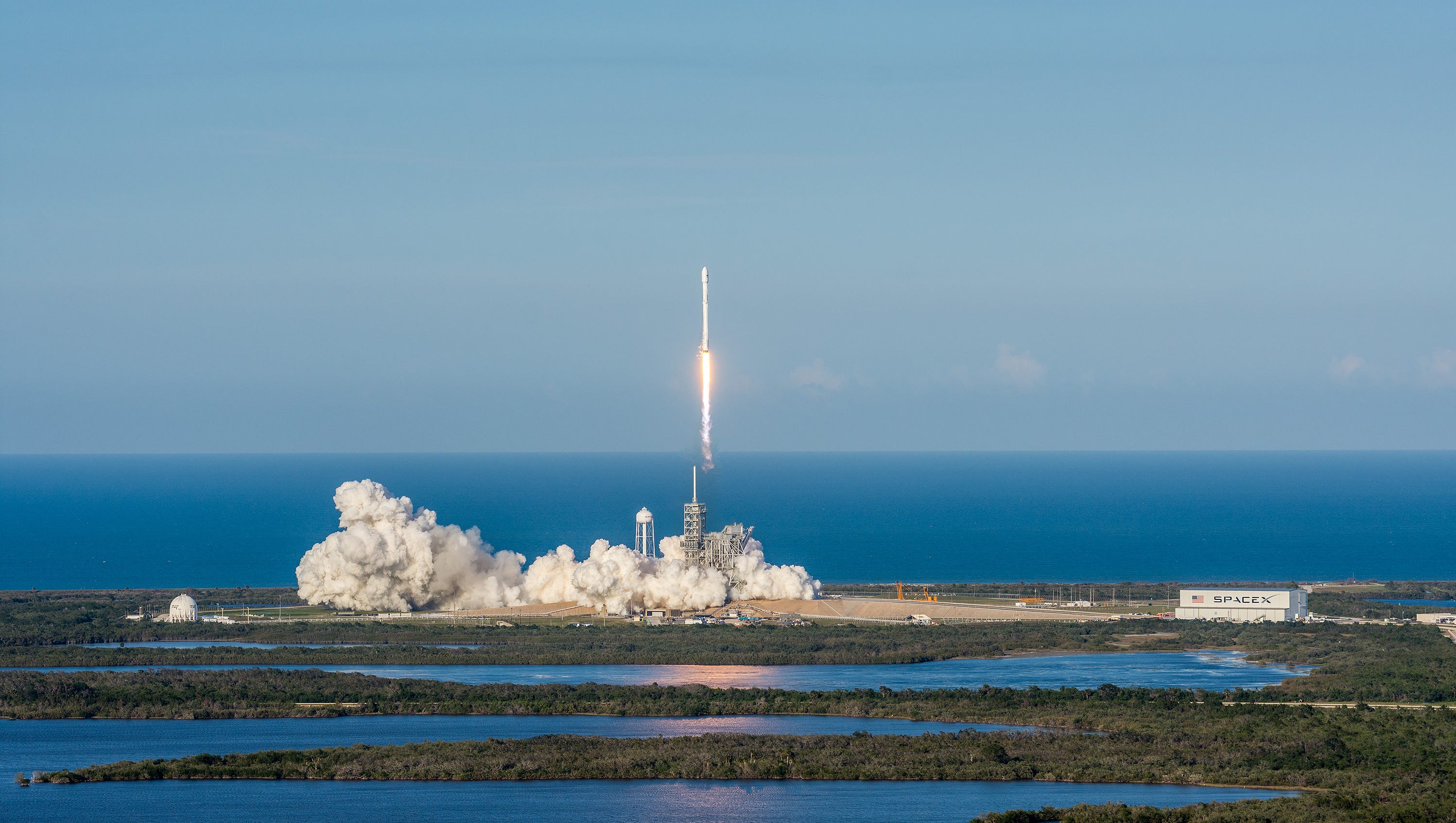
The global aerospace industry is undergoing a historic renaissance, driven by radical innovations in reusable rocket architectures, high-efficiency electric propulsion, and autonomous orbital navigation. For decades, spaceflight was characterized by expendable launch vehicles where multi-million-dollar rockets were flown once and discarded into the ocean. Today, vertical propulsive landing, composite materials, and advanced guidance control systems have transformed space access into a high-cadence, cost-effective industrial logistics network. This technical review examines the engineering pillars of modern space exploration. The foundational engineering breakthrough enabling modern reusability is precise retro-propulsion and guidance navigation control (GNC). Reusable orbital-class boosters must re-enter Earth's atmosphere traveling at hypersonic velocities, subjecting airframes to extreme thermal friction and aerodynamic stress. By executing controlled atmospheric entry burns, deploying titanium grid fins for aerodynamic steering, and reigniting main rocket engines seconds before touchdown, boosters land upright on autonomous drone ships or concrete pads with pinpoint accuracy. This capability slashes cost-per-kilogram launch economics by orders of magnitude. Beyond atmospheric rocketry, deep-space exploration relies heavily on advanced propulsion systems, most notably Hall-effect thrusters and ion propulsion. While chemical rockets provide immense thrust for liftoff, their fuel efficiency (specific impulse) is limited. Ion engines utilize solar-generated electricity to ionize noble gases like xenon or krypton, accelerating the resulting ions through high-voltage electrostatic grids to expel exhaust at speeds exceeding 40 kilometers per second. Though generating gentle acceleration, ion propulsion runs continuously for months, enabling deep-space interplanetary missions. This article details orbital transfer mechanics, thermal protection shields, and deep-space telemetry.
Why this matters now
Technology rarely arrives as a single breakthrough. It emerges from a chain of research decisions, infrastructure investments, and practical constraints. The global aerospace industry is undergoing a historic renaissance, driven by radical innovations in reusable rocket architectures, high-efficiency electric propulsion, and autonomous orbital navigation. For decades, spaceflight was characterized by expendable launch vehicles where multi-million-dollar rockets were flown once and discarded into the ocean. Today, vertical propulsive landing, composite materials, and advanced guidance control systems have transformed space access into a high-cadence, cost-effective industrial logistics network. This technical review examines the engineering pillars of modern space exploration. The foundational engineering breakthrough enabling modern reusability is precise retro-propulsion and guidance navigation control (GNC). Reusable orbital-class boosters must re-enter Earth's atmosphere traveling at hypersonic velocities, subjecting airframes to extreme thermal friction and aerodynamic stress. By executing controlled atmospheric entry burns, deploying titanium grid fins for aerodynamic steering, and reigniting main rocket engines seconds before touchdown, boosters land upright on autonomous drone ships or concrete pads with pinpoint accuracy. This capability slashes cost-per-kilogram launch economics by orders of magnitude. Beyond atmospheric rocketry, deep-space exploration relies heavily on advanced propulsion systems, most notably Hall-effect thrusters and ion propulsion. While chemical rockets provide immense thrust for liftoff, their fuel efficiency (specific impulse) is limited. Ion engines utilize solar-generated electricity to ionize noble gases like xenon or krypton, accelerating the resulting ions through high-voltage electrostatic grids to expel exhaust at speeds exceeding 40 kilometers per second. Though generating gentle acceleration, ion propulsion runs continuously for months, enabling deep-space interplanetary missions. This article details orbital transfer mechanics, thermal protection shields, and deep-space telemetry. This context matters because the most useful way to evaluate a new system is not to ask whether it is impressive in isolation, but whether it changes what people can reliably do, at what cost, and with which risks. For researchers and builders, that means separating the demonstration from the durable capability.
A responsible reading of space exploration technology: reusable rocketry, ion propulsion, and orbital mechanics also requires attention to who benefits and who carries the cost. Teams should document assumptions, monitor drift, and give affected people a meaningful way to challenge automated decisions. These are not secondary considerations: they determine whether a promising technical idea becomes dependable infrastructure.
The architecture behind the promise
The global aerospace industry is undergoing a historic renaissance, driven by radical innovations in reusable rocket architectures, high-efficiency electric propulsion, and autonomous orbital navigation. For decades, spaceflight was characterized by expendable launch vehicles where multi-million-dollar rockets were flown once and discarded into the ocean. Today, vertical propulsive landing, composite materials, and advanced guidance control systems have transformed space access into a high-cadence, cost-effective industrial logistics network. This technical review examines the engineering pillars of modern space exploration. The foundational engineering breakthrough enabling modern reusability is precise retro-propulsion and guidance navigation control (GNC). Reusable orbital-class boosters must re-enter Earth's atmosphere traveling at hypersonic velocities, subjecting airframes to extreme thermal friction and aerodynamic stress. By executing controlled atmospheric entry burns, deploying titanium grid fins for aerodynamic steering, and reigniting main rocket engines seconds before touchdown, boosters land upright on autonomous drone ships or concrete pads with pinpoint accuracy. This capability slashes cost-per-kilogram launch economics by orders of magnitude. Beyond atmospheric rocketry, deep-space exploration relies heavily on advanced propulsion systems, most notably Hall-effect thrusters and ion propulsion. While chemical rockets provide immense thrust for liftoff, their fuel efficiency (specific impulse) is limited. Ion engines utilize solar-generated electricity to ionize noble gases like xenon or krypton, accelerating the resulting ions through high-voltage electrostatic grids to expel exhaust at speeds exceeding 40 kilometers per second. Though generating gentle acceleration, ion propulsion runs continuously for months, enabling deep-space interplanetary missions. This article details orbital transfer mechanics, thermal protection shields, and deep-space telemetry. At implementation level, the important trade-offs are usually found at the boundaries: data quality, latency, energy use, interfaces, and the evaluation methods used to measure success. A model or device can score highly in a controlled benchmark while behaving differently in a noisy production environment. Robust systems therefore combine specialized components, transparent instrumentation, and feedback loops that make errors visible. This is also where open standards and reproducible research create leverage: they allow independent teams to verify claims and improve the baseline rather than treating every product as a black box.
A responsible reading of space exploration technology: reusable rocketry, ion propulsion, and orbital mechanics also requires attention to who benefits and who carries the cost. Teams should document assumptions, monitor drift, and give affected people a meaningful way to challenge automated decisions. These are not secondary considerations: they determine whether a promising technical idea becomes dependable infrastructure.
What the evidence suggests
The current evidence points to a more nuanced picture than the headlines imply. Capabilities are advancing quickly, but performance remains uneven across languages, edge cases, operating conditions, and user populations. The strongest deployments define a narrow job, establish a human-review path, and measure outcomes over time. Independent audits, peer-reviewed findings, and technical documentation are more valuable than a single launch demonstration. Readers should look for clearly defined metrics, disclosed limitations, and comparisons against a meaningful baseline.
A responsible reading of space exploration technology: reusable rocketry, ion propulsion, and orbital mechanics also requires attention to who benefits and who carries the cost. Teams should document assumptions, monitor drift, and give affected people a meaningful way to challenge automated decisions. These are not secondary considerations: they determine whether a promising technical idea becomes dependable infrastructure.
The practical horizon
Over the next several years, progress will likely come from engineering discipline as much as from larger models or more powerful hardware. Better data pipelines, efficient inference, domain-specific evaluation, and thoughtful product design can make existing capabilities substantially more useful. Organizations considering adoption should begin with a measurable workflow, record the cost of today’s process, and test whether the technology improves quality without creating unacceptable operational or privacy risk. The winners will be the systems that earn trust through consistency, not simply novelty.
A responsible reading of space exploration technology: reusable rocketry, ion propulsion, and orbital mechanics also requires attention to who benefits and who carries the cost. Teams should document assumptions, monitor drift, and give affected people a meaningful way to challenge automated decisions. These are not secondary considerations: they determine whether a promising technical idea becomes dependable infrastructure.
Sources & further reading
This analysis is based on the provided research brief and the source selected by its editors.
Aerospace Engineering & Space Technology Review